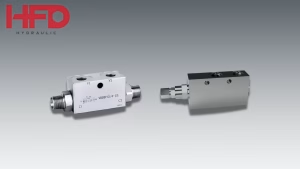
Quick Overview
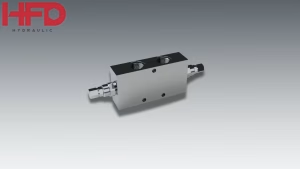
A differential-acting sequence valve uses a piston with two unequal working areas, instead of a spring-loaded spool or poppet alone, to open a secondary circuit once the primary circuit reaches a set pressure. The HFD VDSD/B applies this principle to stay accurate even when the outlet side sees back pressure — without needing a separate external drain line. It’s rated to 350 bar and 200 l/min, and it ships in four sizes (VDSD/B 38, 12, 34, 100) to cover ports from G3/8 up to G1″.
Sequence valves are supposed to do one simple job: hold flow back from a secondary circuit until the primary circuit hits a target pressure. In practice, that “simple job” gets complicated the moment there’s back pressure sitting on the outlet side of the valve — a return line sharing a manifold with other functions, a cooler or filter downstream, or a second machine drawing off the same tank line. Back pressure on the outlet can shift the effective opening point of an ordinary spring-loaded sequence valve, so the sequence stops happening at the pressure you actually set.
There are two established ways to solve that problem. One is to add an external drain port that vents the spring chamber straight to the tank, which is how HFD’s direct-acting back pressure-proof sequence valve VDSRL/APP handles it. The other is to build the valve around a differential piston instead of a simple spring-and-poppet, which is the approach behind the VDSD/B differential-acting sequence valve. Both land in the same place — a sequence valve whose trip point doesn’t drift with outlet pressure — but they get there through different internal geometry, and that difference affects how each valve gets plumbed into a circuit.
This article covers how the differential-acting design works, where the VDSD/B fits alongside HFD’s other sequence valve types, its ratings, and the applications where a differential piston is the right call.
What “Differential-Acting” Actually Means
Every hydraulic sequence valve, regardless of type, blocks flow to a secondary circuit until pressure on the primary side reaches a preset value, then opens to let that secondary circuit run. A basic direct-acting valve does this with a spool or poppet held shut by a spring — pressure at the inlet pushes against the spring, and once it wins, the valve opens.
A differential-acting valve like the VDSD/B does the same job with a different mechanism. Inside the valve, a piston separates two ports — commonly labeled D (inlet/primary) and C (outlet/secondary) — and the piston has two working areas of different size. Pressure at D acts on one face of the piston; because the areas are unequal, it takes a specific pressure at D, working against the spring setting, to shift the piston and open the path through to C. Critically, pressure sitting on the C side doesn’t act against that same differential in a way that changes the trip point — back pressure downstream doesn’t creep into the setting the way it can with a simple spring valve. Flow in the reverse direction, from C back to D, is handled separately through a built-in check valve, so the valve doesn’t block return flow once the sequence is done.
The practical upshot is a two-port inline valve (D and C, no separate drain line to route) that still holds its set pressure accurately even when the outlet sees fluctuating back pressure. That’s a meaningfully simpler installation than a drained sequence valve, which needs a third port piped back to the tank on its own.
VDSD/B vs. the Rest of HFD’s Sequence Valve Line
HFD’s sequence valve range gives you three ways to get a pressure-triggered, back-pressure-tolerant sequence, and each is worth knowing before you spec a job:
- Direct-acting sequence valve (VDSRL) — the simplest architecture: spring-loaded poppet, lowest cost, fewest parts. Best suited to lower-flow circuits where outlet back pressure is minimal or constant, since a plain direct-acting valve is the design most sensitive to back-pressure drift.
- Direct-acting back pressure-proof sequence valve (VDSRL/APP) — solves the back-pressure problem with an external drain port that isolates the spring chamber from outlet pressure. Needs the extra drain line routed to tank.
- Differential-acting sequence valve (VDSD/B) — solves the same back-pressure problem through piston geometry instead of a drain line, so it stays a two-port, inline valve. Trades the simplicity of the direct-acting VDSRL for back-pressure immunity, without adding the plumbing of a drained valve.
If a circuit has a clean, low-pressure return line and cost is the priority, VDSRL is usually enough. If outlet pressure is genuinely variable and you’d rather not add a drain line, VDSD/B is the more direct swap. If you’re already running a drain line elsewhere in the manifold and want the most predictable trip point available, VDSRL/APP is worth the extra port.

VDSD/B Specifications
The VDSD/B is available in four body sizes, sized by nominal flow and port size:
| Size | Nominal flow | Ports (BSP) | Ports (SAE) |
| VDSD/B 38 | 30 l/min (7.9 US gpm) | G3/8 | SAE 8 |
| VDSD/B 12 | 60 l/min (16 US gpm) | G1/2 | SAE 10 |
| VDSD/B 34 | 120 l/min (31.7 US gpm) | G3/4 | SAE 12 |
| VDSD/B 100 | 200 l/min (52.8 US gpm) | G1″ | SAE 16 |
Across all four sizes:
- Max pressure: 210 bar (3,050 psi) in aluminum body, 350 bar (5,100 psi) in steel body
- Fluid: mineral-based oil, viscosity range 10–200 cSt
- Max contamination level: ISO 4406 18/16/13
- Fluid temperature (NBR seals): -20°C to 80°C (-4°F to 176°F)
- Environmental/ambient temperature: -40°C to 100°C (-40°F to 212°F)
- Weight: from 0.60 kg (aluminum, VDSD/B 38) up to 4.82 kg (steel, VDSD/B 100)
The steel-body option is worth flagging for anyone speccing above roughly 210 bar — the aluminum body covers most mobile and industrial circuits, but systems running closer to 300+ bar need the steel variant to stay within rating.
Where Differential-Acting Sequence Valves Fit
Clamp-and-work circuits with a shared or variable return line
The classic sequence valve application — clamp a workpiece, then run a press, drill, or bending operation — works on any sequence valve type. Where the differential-acting design earns its place is when the return lines from the clamp and work cylinders share a manifold with other functions, or feed through a cooler, filter, or another valve bank before reaching the tank. Any of those can put a variable back pressure on the sequence valve’s outlet port. A VDSD/B holds its trip pressure steady in that situation, so the clamp force stays consistent regardless of what else the return line is doing at that moment — which matters on presses and stamping equipment where inconsistent clamp force means inconsistent part quality.
Accumulator charge and unloading circuits
Sequence valves — including the VDSD/B alongside the VDSRL/APP — also show up in automatic reversing/unloading circuits built around accumulators. In that arrangement, the sequence valve allows pump discharge once pressure at the working port reaches the set value, then the valve holds that pressure roughly constant as the accumulator takes over supplying the circuit. The valve’s job here isn’t a one-shot clamp-then-work sequence but an ongoing pressure-holding function, and outlet-side pressure swings as the accumulator charges and discharges are exactly the condition a differential-acting design is built to shrug off.
Multi-branch mobile and industrial manifolds
On equipment where several functions tie into a common return manifold — outrigger legs, auxiliary attachments, or secondary work circuits on excavators, cranes, and similar mobile machinery — the return-line pressure at any given sequence valve isn’t constant; it depends on what else is running at the same time. A two-port differential-acting valve is a straightforward way to keep a sequencing function accurate on that kind of manifold without adding a dedicated drain line back to the tank for every valve on the block.

Retrofits where routing a drain line isn’t practical
Because the VDSD/B only needs its two working ports connected, it’s also a reasonable substitute for a back pressure-proof drained valve in situations where there’s genuinely no clean path to run a third line to tank — tight manifold space, a cartridge cavity with no spare port, or a retrofit into an existing block that wasn’t drilled for a drain.
Choosing Between the Three Types
As a rule of thumb: start with the simplest option that will actually hold its setting in your circuit. If the return line is quiet and low-pressure, the direct-acting VDSRL is the lowest-cost, lowest-part-count choice. If back pressure is a real factor, decide based on plumbing — add a drain line and go with VDSRL/APP if you already have the routing for it, or keep the circuit to two ports and specify VDSD/B if you don’t. Flow rate and system pressure, then narrow the size: match nominal flow to the VDSD/B 38/12/34/100 table above, and step up to the steel body if operating pressure runs above 210 bar.

A differential-acting sequence valve isn’t a different function from a direct-acting or back pressure-proof one — all three deliver the same pressure-triggered sequencing. What changes is how the valve stays accurate when the outlet side of the circuit isn’t quiet, and how much plumbing that accuracy costs you. The VDSD/B’s differential piston buys back-pressure immunity without a third port, which makes it a practical middle ground between a basic direct-acting valve and a fully drained one — particularly on manifolds where routing an extra line to tank isn’t simple.
Need help sizing a differential-acting sequence valve for your circuit? Browse our sequence valve catalog or contact us for a free quote.