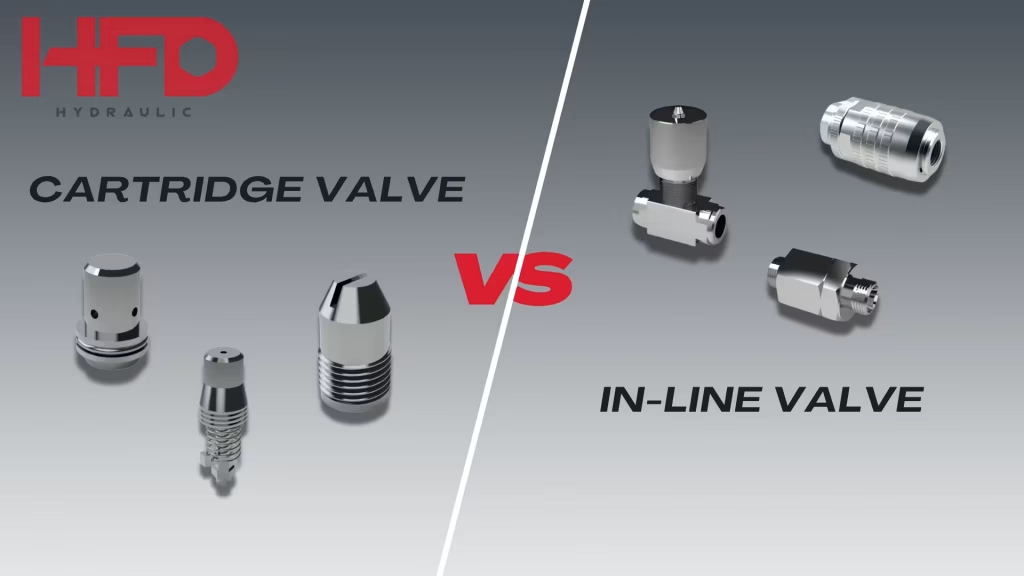
Ask a room of hydraulic engineers whether to specify a cartridge valve or an in-line valve, and you will hear “it depends” more than once. That is an honest answer. Both designs control the same oil and do the same jobs. They simply put the complexity in different places: one inside a block of metal, the other along the pipe run.
The basics of cartridge valves are already covered in our guide to understanding cartridge valves in hydraulic systems, so this article skips them. Instead, it helps you decide which mounting approach fits your machine, your production volume, and the people who will service it. It also shows where HFD’s in-line valves fit into the picture.
Quick Overview
What is the difference between a cartridge valve and an in-line valve?
A cartridge valve is a self-contained valve element that installs into a machined cavity in a manifold block. An in-line valve has its own body and ports and connects directly into the hydraulic line. Cartridge valves suit compact, multi-function circuits. In-line valves suit simple circuits, retrofits, and easy field replacement.
Which one should you choose?
- Choose a cartridge valve when several functions share one block, space and weight are tight, and you build in volume.
- Choose an in-line valve when the circuit is simple, you are repairing or retrofitting a machine, or you need parts you can see and swap easily.
- Use both when a manifold handles the main circuit and in-line valves protect or serve individual actuators.
Summary
The right valve depends on circuit complexity, production volume, and service needs, not on which design is newer. Match the mounting method to the machine.
The Core Difference: Where the Valve Lives
A cartridge valve is a working element, not a complete valve body. Its poppet, spool, spring, and seals sit in a cylindrical cartridge that threads or slips into a precision-machined cavity in a manifold block. The block provides the flow paths, and the cartridge provides the function. That is why one manifold can carry a relief valve, a check valve, and a flow control side by side, with the connections between them drilled inside the metal. Our hydraulic manifold valve guide explains how those blocks are built.
An in-line valve works the opposite way. It has its own body and its own ports, and it connects straight into the hose or tube run. The valve is the connection, so no manifold is needed. You can place it wherever the circuit needs control: at the pump outlet, near a cylinder, or on a return line. Our overview of hydraulic in-line valves covers the main types.
So the real difference is where the complexity lives. With cartridges, it lives in the manifold design. With in-line valves, it lives in the plumbing.
Cartridge Valve vs In-Line Valve: Side-by-Side Comparison
| Factor | Cartridge valve | In-line valve |
| Footprint | Very compact when several functions share one block | Each valve takes its own space in the line |
| Leak points | Fewer external joints; inter-valve paths are internal | More fittings as functions are added |
| Installation | Needs a machined manifold; valves then drop in | Connects directly into hose or tube; no manifold |
| Field service | Fast cartridge swaps, but valves are hidden in the block | Visible and easy to isolate and replace |
| Upfront cost | Manifold design and machining; pays off at volume | Low for one-offs and small batches |
| Design changes | Swap cartridges; new flow paths mean a new block | Add, move, or replace valves in the line |
| Typical use | Excavators, forklifts, presses, multi-function machines | Retrofits, single-function circuits, protection valves |
The pattern is a trade of effort. A cartridge valve moves the work to the design stage, then pays you back in production and service. An in-line valve keeps upfront work low and the layout flexible, but every added function adds fittings.
One honest downside of manifolds is visibility. Machinery Lubrication points out that valves buried in a block can be confusing to troubleshoot, so technicians end up relying on the hydraulic schematic instead of what they can see. With in-line valves, you can simply trace the line and find the valve.
Cost also deserves a closer look. A cartridge system can be cheaper per machine once volumes justify the manifold, but for a single prototype the machining and design time usually outweigh any savings. An in-line valve has almost no setup cost, which makes it a natural fit for low-volume work.
When a Cartridge Valve Is the Better Choice
Cartridge valves earn their place when at least one of these is true.
The circuit has many functions. Once a single cylinder needs relief, check, flow control, and load holding, plumbing each function separately adds fittings, hose, and leak paths. Plant Engineering notes that manifolds cut piping, which reduces both leakage and pressure drop. A block with four or five cartridges keeps all of that inside one part.
Space and weight are tight. Excavators, forklifts, and other mobile machines have little room to spare. A manifold packs several functions into a small block that can sit close to the actuator it serves. That saves hose length, weight, and installation time.
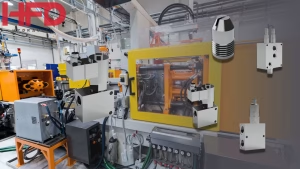
You build in volume. Machining a manifold costs money up front, but spread across hundreds of machines that cost shrinks, and assembly gets faster because valves drop into a prepared block. Hydraulic presses and injection molding machines are classic multi-function examples, and our article on hydraulic control valves in presses and injection molding machines covers the valves used in them.
External joints are a liability. Vibration, dirt, and heavy-duty cycles punish threaded fittings, and fewer external joints means fewer places for oil to escape.
One sourcing note: Plant Engineering points out that cartridge sizes have no single official dimensional standard, although most major manufacturers offer interchangeable designs. Confirm the cavity match before assuming a cartridge will fit. HFD’s pressure-compensated cartridge regulators, the VSCOR, VDR, and VDR/CO, are built for these manifold circuits, and the cartridge valve guide covers them in detail.
When an In-Line Valve Is the Better Choice
In-line valves win when simplicity, flexibility, or serviceability matters more than compactness.
The circuit is simple. A single check valve, relief valve, or speed control does not justify designing a manifold.
You are repairing or retrofitting. Existing machines already have hose and tube runs, and an in-line valve goes into that run without redesigning anything else.
Volume is low or varied. Small batches, prototypes, and mixed fleets rarely justify a custom block.
Field service matters. A visible valve on an accessible line is easy to isolate, inspect, and replace.
Four HFD valves show what this looks like in practice.
SY-RD In-Line Check Valve
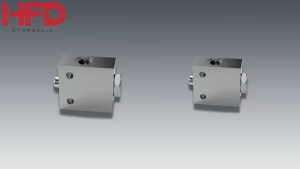
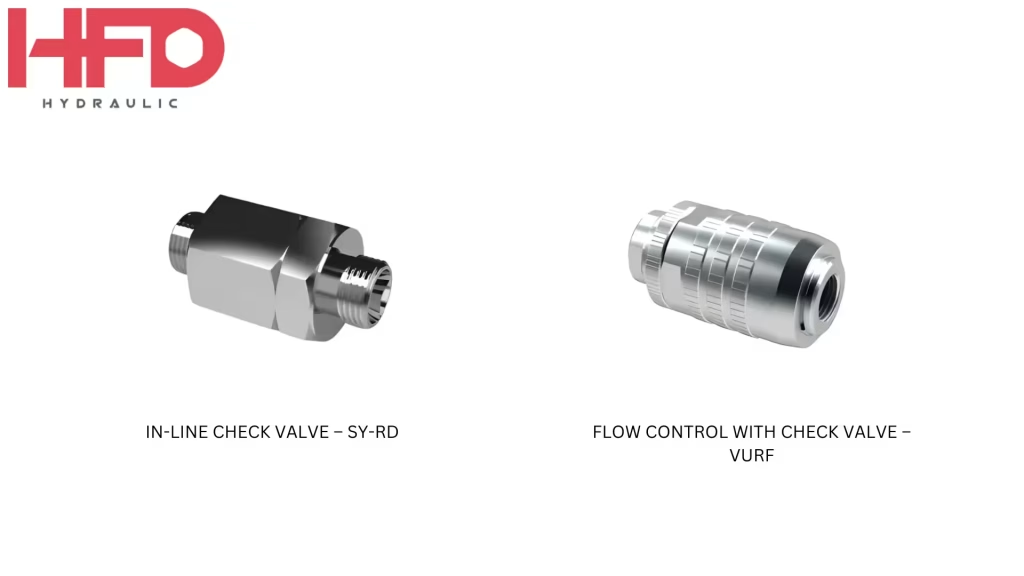
The SY-RD is a compact in-line check valve with a zinc-plated steel body, a hardened steel valve, and a captive nitrile seal. HFD lists a cracking pressure of 7 psi. It comes in L and S series, with pipe sizes from 6 mm up to 42 mm on the L series and pressure ratings from 250 to 400 bar depending on size. It is the simplest example of a valve that needs no manifold at all. See our article on in-line hydraulic check valves for more.
VURF Flow Control with Check Valve
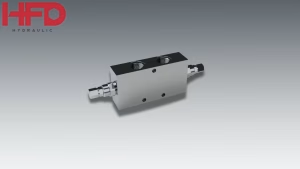
The VURF combines an adjustable restrictor with an integrated check valve. It limits flow in one direction and lets oil return freely the other way, a common setup for controlling cylinder speed. It is available with G1/4 to G1 ports, handles 12 to 100 L/min depending on size, and is rated up to 320 bar. It is the in-line counterpart to the cartridge flow regulators above, and our flow control valve article goes deeper on the topic.
STB Bi-Directional Flow Restrictor
The STB restricts flow in both directions, which suits circuits where speed needs controlling either way. It has compact inline porting, G1/4 to G1 connections, flows of 12 to 100 L/min, and pressure ratings up to 400 bar on most sizes. Unit weight ranges from 0.21 to 1.52 kg.
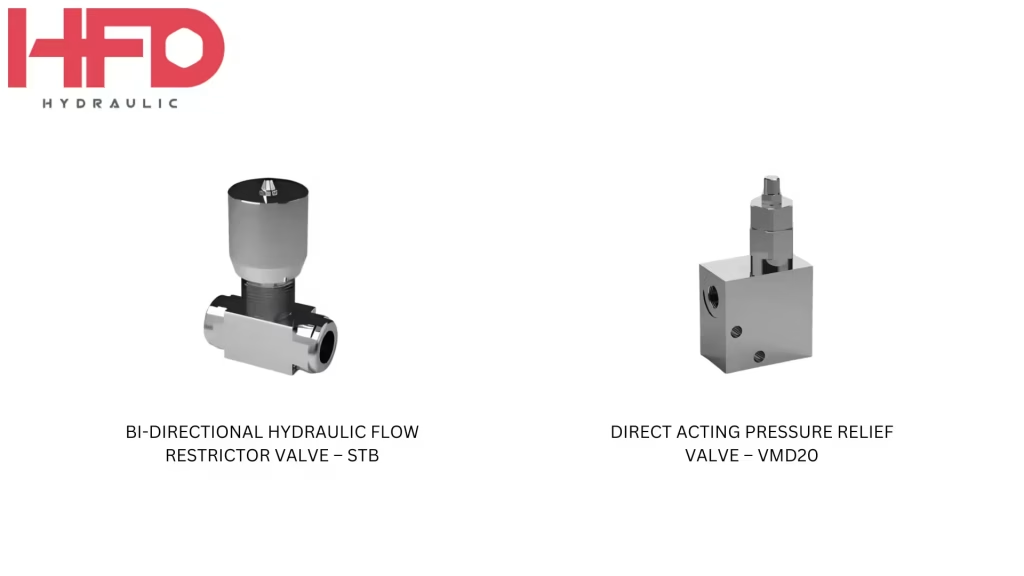
VMD20 Direct-Acting Relief Valve
The VMD20 is a direct-acting relief valve with G1/4 or G3/8 ports. The aluminum body is rated up to 210 bar and the steel version up to 350 bar. It is a compact way to add overpressure protection to a single circuit without a dedicated manifold cavity. For more on the topic, read our guide to in-line pressure relief valves in mobile hydraulics.
Can You Use Both?
Often, yes. Nothing forces you to choose one approach for the whole machine.
One practical pattern is a cartridge manifold for the main control block, where several functions share space, with in-line valves elsewhere for jobs that do not need a block. A relief valve protecting an auxiliary circuit is one example. A check valve on a single branch is another. For instance, a mobile machine might use a manifold for its main hydraulic functions and add a single in-line check valve on an auxiliary line, where a separate manifold cavity would be overkill. Both valve types share one system without getting in each other’s way.
Plant Engineering also notes that functions such as flow control and counterbalance can be built into a manifold mounted on or close to the actuator, so where those valves go is a design decision, not a rule.
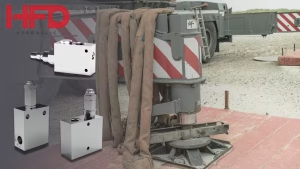
Load holding is a good case to think through. Overcenter valves keep loads from running away on cylinders such as crane outriggers, and they are typically installed at or near the cylinder. Our articles on what an overcenter valve is and overcenter valves for truck-mounted crane outriggers show how they are used.
Decision Checklist: Cartridge Valve or In-Line Valve?
Work through these seven questions. If most answers point the same way, you have your choice.
- How many functions does each actuator need? One or two usually favors in-line valves. Four or more, as a rule of thumb, starts to favor a manifold.
- How many machines will you build? Small runs favor in-line valves. Larger runs justify manifold tooling.
- How tight are space and weight? Tight limits favor cartridges.
- Is this a new design or a repair? New designs can go either way, while repairs and retrofits usually favor in-line valves.
- Who services it, and where? Field service on a visible line favors in-line valves. A controlled workshop suits manifold cartridges.
- How will you source parts? In-line valves connect through standard threaded ports, such as the G-series ports on the VURF, STB, and VMD20, while cartridges need a matching cavity.
- Will the circuit change later? Adding an in-line valve is quick, while new flow paths in a manifold may mean a new block, although swapping cartridges in an existing cavity is easy.
If your answers split, a hybrid design is usually the sensible middle ground. Not sure which suits your application? Browse the HFD valve range or contact our team for help choosing.
Choosing the Right Valve Mounting Approach
Cartridge valves and in-line valves are not rivals. They are two answers to the same question: where should the control live? Cartridge valves pull it into a compact manifold, which pays off in multi-function, space-limited, high-volume designs. In-line valves keep it on the line, which pays off in simple, flexible, easily serviced systems. Start with the circuit, then count the functions, volumes, and service conditions, and the right choice usually becomes clear. When it does not, combine them and work with a supplier who makes both kinds of valve.